
I’ve been curious about freediving ever since a lung capacity test in high school revealed that I was above average. That small discovery stuck with me, resurfacing now and then in the back of my mind. But I never acted on it until more than a decade later.
Rather than ticking off the usual things to do in the Philippines, I set my sights on a proper freediving course. Barracuda Lake in Coron quickly emerged as the perfect place to learn, with its otherworldly waters and dramatic limestone walls.
In this post, I’ll cover my experience of joining a two-day freediving course in Lake Barracuda, what’s unique about the lake, where to stay if you decide to visit as well, whether it’s worth scuba diving there and if it’s really worth visiting (spoiler alert: it’s very much worth visiting).
When to Visit Coron
It’s possible all year‑round, but weather and sea conditions around Coron can affect tours and the overall experience. The best time to visit is during the dry season (December–April), when skies are clear, and tours and boats run reliably. Transitional months (November and May) can still offer good weather, though occasional showers may occur. It’s best to avoid June–September, as heavy rains and rough seas often disrupt tours.
 29°C
25°C
29°C
25°C
30°C
25°C
32°C
26°C
29°C
25°C
29°C
25°C
30°C
25°C
32°C
26°C
 32°C
26°C
32°C
26°C
 31°C
26°C
30°C
26°C
31°C
26°C
31°C
26°C
30°C
26°C
29°C
25°C
29°C
25°C
31°C
26°C
30°C
26°C
31°C
26°C
31°C
26°C
30°C
26°C
29°C
25°C
29°C
25°C
What’s Unique About Barracuda Lake
Barracuda Lake isn’t your typical lake. What stands out the most is its distinct thermocline, where the water temperature gets warmer dramatically as you descend. At surface, it’s a comfortable 28 °C (82 °F), but at the depth of 14 meters it can rise over 38 °C (100 °F) before cooling again closer to the bottom.
This unusual effect happens because the lake is mixed with fresh and saltwater inside a volcanic crater, and its geothermal activity warms the denser, saltier layers creating those crazy shifts in temperatures. There are only two places like this in the world, one in the Philippines and the other one in Mexico.
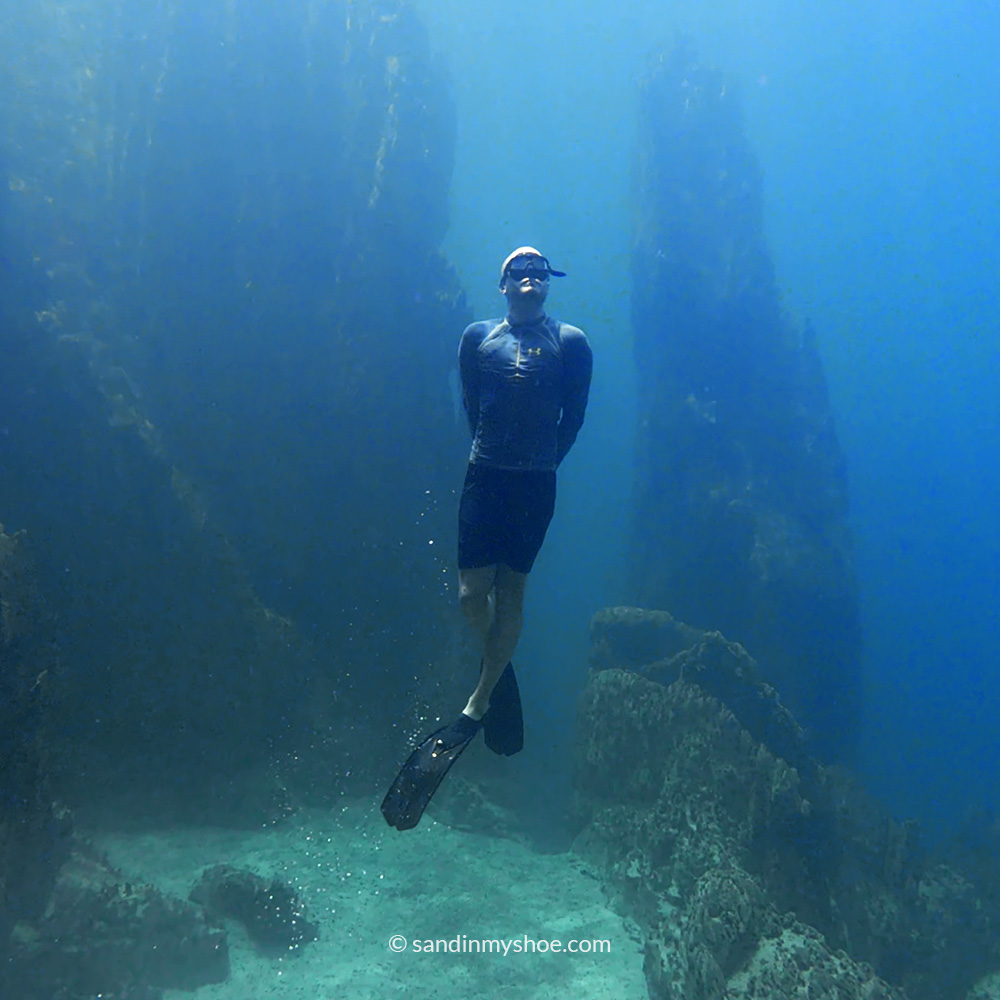
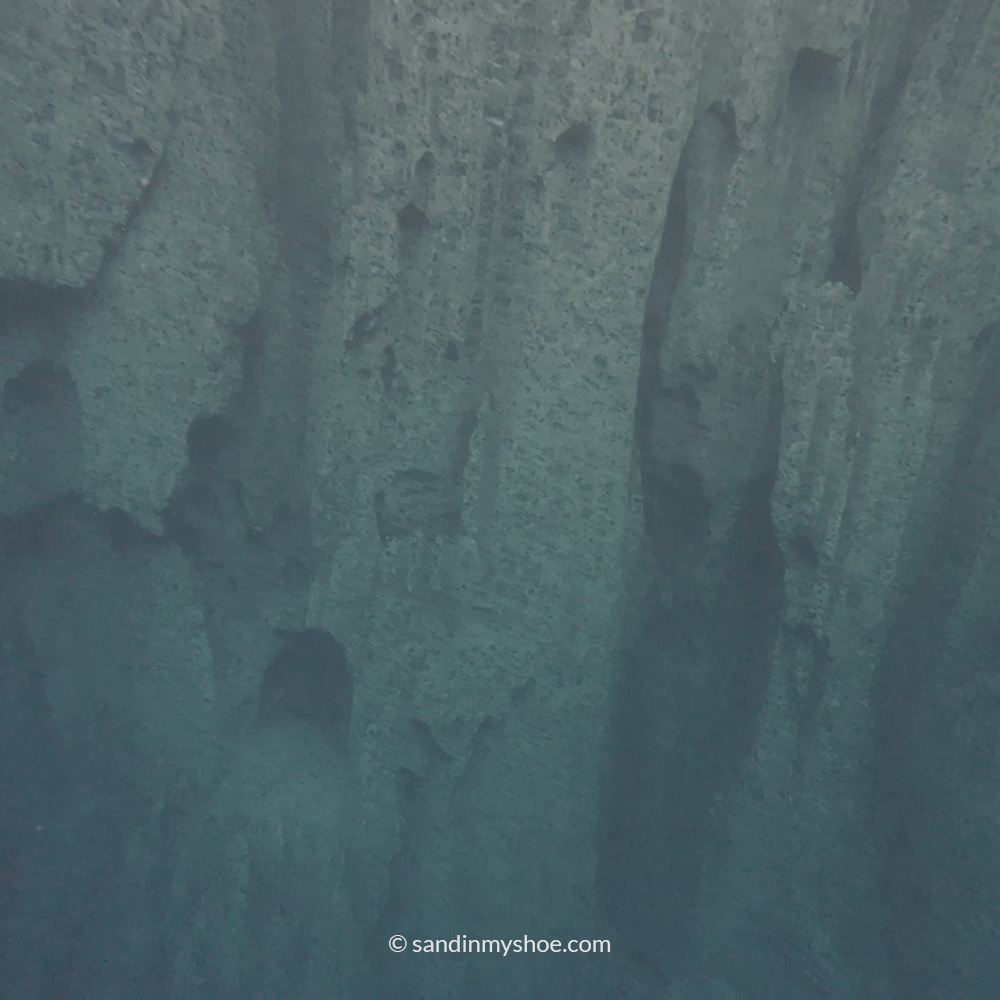
But it’s not only the thermocline that makes the Barracuda Lake special. Above the surface, tall limestone cliffs frame the lake, while jagged saw-toothed limestone spires continue beneath, creating this spooky, otherworldly underwater landscape. And then there’s the visibility. Unlike anything I’ve experienced before, with crystal clear water that let me see easily 15 meters (50 feet) down and probably around 20 meters (65 feet) across — if not more.
Where is Barracuda Lake
Barracuda Lake is located on Coron Island, just off the coast of Busuanga in Northern Palawan, Philippines. It’s about a 20-minute boat ride from Coron Town, followed by a short walk from the wooden dock to the lake itself.
My Experience Freediving at Barracuda Lake, Coron
While in Coron Town, I compared freediving courses in Coron Town and found the prices were all about the same, so I just chose the organizer with the best reviews, and in hindsight it was a great experience.
The two‑day course was split between theory and practice. The theoretical part was held in Coron Town, and to my surprise the instructor turned out to be Swedish as well — probably the only Swede living on Coron Island. What are the odds! The afternoons were dedicated to putting the theory into practice in Barracuda lake’s calm, otherworldly underwater landscape.
Theoretical Part
We began by sharing what we thought we knew about freediving, and the instructor corrected our misconceptions. From there, new knowledge was added with focus on breathing techniques, how to lower the heart rate, safety protocols, and how the body reacts to rising levels of carbon dioxide.
Here are the key lessons we learned.
- Never Freedive Alone: The number one rule. Most freediving accidents happen when someone dives alone or with an inexperienced buddy.
- The Urge to Breathe: That uncomfortable feeling isn’t from lack of oxygen — it’s the buildup of carbon dioxide. In a test, we held our breath as long as possible and measured oxygen afterward. Surprisingly, it was still at 98%. It only becomes dangerous below 80%, when blackout risk rises.
- Do Not Hyperventilate: Once common advice, now considered dangerous. Hyperventilation can cause you to pass out — in the 1990s, many freedivers lost dives because of this.
- Two‑Part Breathing Technique: Round your mouth, inhale to fill your stomach first, then your chest. This way you maximize lung capacity with oxygen.
- Lowering Your Heart Rate: To conserve oxygen, it’s crucial to slow your heart rate. We practiced a variation of Pranayama breathing from yoga:
1. Form lips or tongue into a rounded shape, as if sipping through a straw.
2. Inhale slowly through the mouth, drawing air deep into the lungs.
3. Press the tongue gently against the roof of the mouth as you exhale.
4. Release the breath with a soft, steady hissing sound.
- Diaphragm Contractions: After about a minute of breath‑holding, the diaphragm starts to contract. At first it feels alarming, but I learned that the first contraction means you still have roughly the same amount of time left before risking blackout.
- Passing Out in Water: If someone loses consciousness, the body reflexively prevents water from entering the lungs. To help, blow gently across their face so the body recognizes it’s no longer submerged, call their name, and tap their cheek.
Practical Part in Barracuda Lake
After theory lessons on both days, we boarded a bangka boat bound for Barracuda Lake. We were three students and our instructor. Once ashore, we followed the wooden planks leading to the lake and jumped in, swimming past the small section set aside for mass tourism toward the other side reserved for divers and freedivers.
There, the instructor set up the freediving rope. One by one, we calmed our heart rates with the Pranayama breathing technique before descending along the rope while the instructor descended alongside us, observing how we handled equalization, diaphragm contractions, and other challenges.
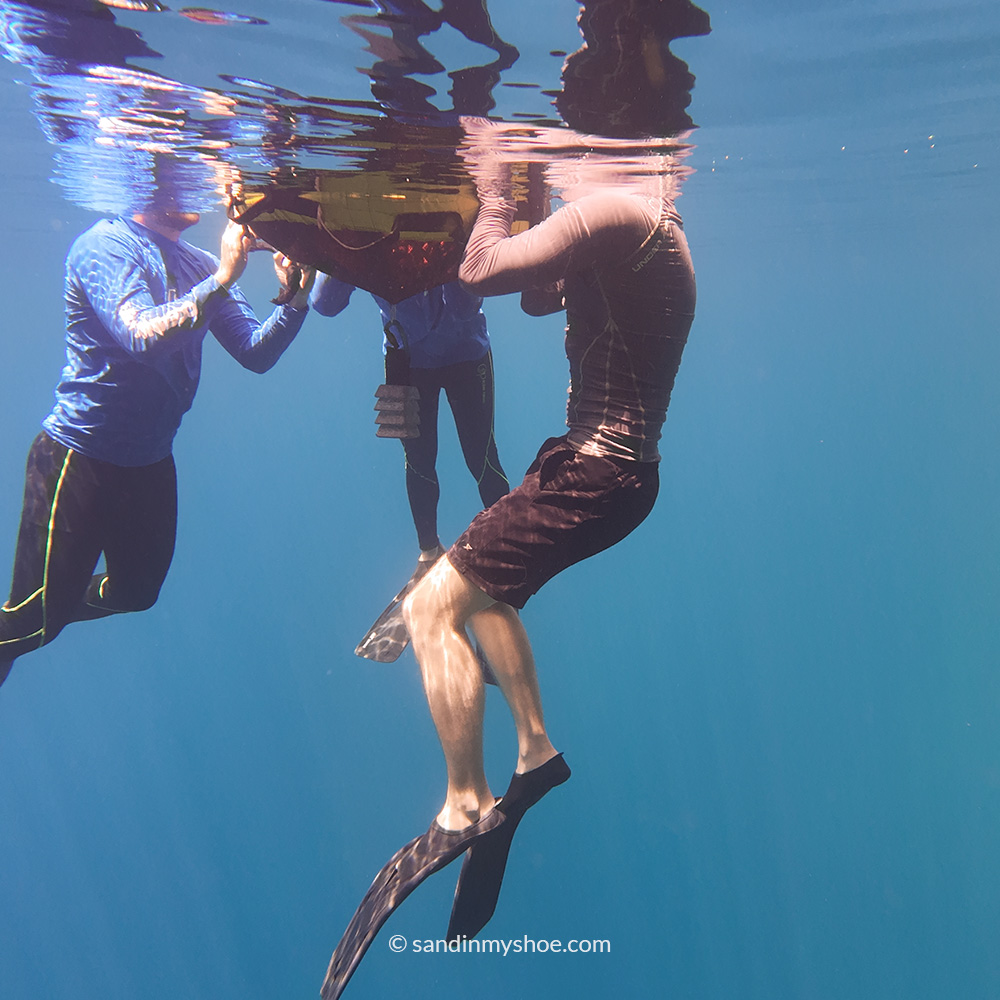
For me, the hardest skill to learn was to properly equalize the pressure in the ears, but with each dive it got better.
The goal of the two-day course was to reach 20 meters — calmly, both on the way down and back up. Because panic makes the heart race, consume oxygen faster, clouding judgment, and increasing the risk of blackout.
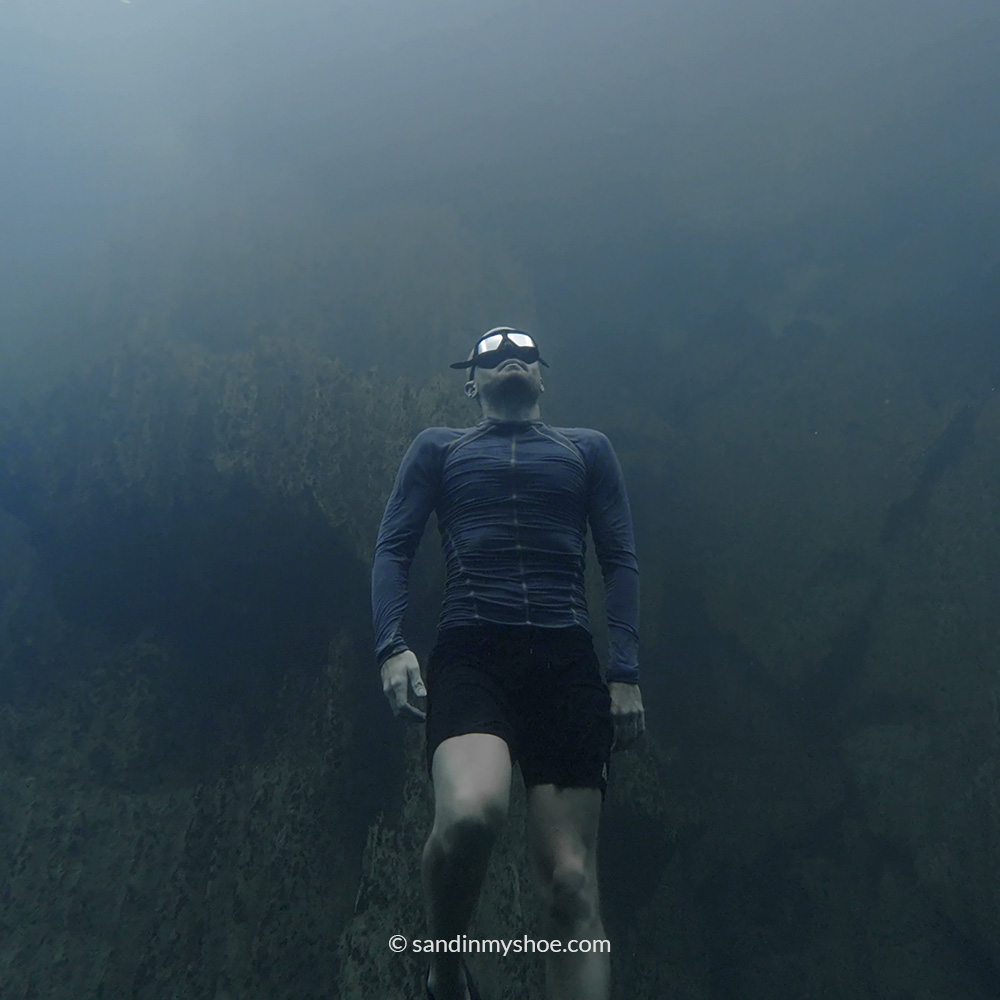
On the first day, 20 meters felt impossible. In my mind, it was beyond human limits — I had only ever reached that depth while scuba diving. The first day I managed to go down to around 14 meters. But on the second day, I surprised myself by descending to 22 meters and with relative calmness.
The scary part was to go below 14 meters because the water shifts — suddenly groggy and warmer than your blood. It feels like being wrapped in a jacuzzi, with 14 meters of water above you, while each meter deeper makes makes the surroundings darker. At first it’s unsettling, but once you push through a couple of times, it becomes easier. Also knowing that you can swim roughly one meter per second back to the surface makes it feel manageable. And unlike scuba diving, freediving requires no safety stops.
My longest breath‑hold was 2 minutes and 15 seconds while going down to roughly 12 meters, which left me satisfied. Beyond rope drills, we explored Barracuda Lake freely, diving around striking spots and even passing through an underwater tunnel 14 meters down that sent my adrenaline soaring.
Two to three hours of training each day left us exhausted. Freediving really takes a toll on the whole body, as oxygen is stripped from every muscle. Yet I really enjoyed the experience, because it demanded full presence and pushed the limits of what I once thought was impossible.
How to Get to Barracuda Lake
The only way to reach Barracuda Lake is by boat, with the ride taking about 20 minutes from Coron town. If you’re an experienced freediver and already have a safety buddy, you can try speaking directly with boat operators at the docks to arrange a trip. Otherwise, the simplest option is to connect with one of the local freediving shops, which regularly organize visits to the lake.
If you are not planning to freedive, but still want to visit the lake consider joining one of the popular island hopping tours.
Barracuda Lake Tours — Island Hopping
There are many different island hopping tours to join, the most popular one is the Super Ultimate Tour, which covers the best spots including the Barracuda Lake, but you can only snorkel in a small area for safety reasons and the rest is designated for divers and freedivers.
Freediving vs Diving in Lake Barracuda
Each time we began our practical sessions, we swam across the lake and saw streams of bubbles rising the from below. So the lake attracts scuba divers to the depths as well, but the experience is quite different depending on how you descend.
Freediving gave me the chance to feel the dramatic temperature shifts multiple times a day, since you can ascend and descend freely. Scuba divers, on the other hand, can’t move up and down as quickly because of gas buildup in the bloodstream, which makes repeated thermocline crossings less practical.
As the lake doesn’t contain much marine life, the real highlight is the thermocline and the surreal volcanic landscape. If you want to experience that fully, I’d recommend freediving — though scuba diving remains a solid second‑best option.
Where to Stay in Coron
Coron Town offers many options of accommodation, and you can even stay in secluded islands around Coron if you are feeling adventurous and have a budget for it.
- High-end: For an exclusive stay, consider Discovery Coron formerly Club Paradise Palawan. It’s located on it’s own private island and is highly praised, but a bit pricey. ~$350 USD per night.
- Mid-range: Coron Westown Resort — a comfortable stay with spacious rooms and a large pool, perfect for unwinding after island tours. ~$60 USD per night.
- Budget: Happy Camper Hostel — a friendly option with both private rooms and dormitories, ideal for travelers looking to save while staying social. Dorm bed cost around $10 USD or roughly $30 USD for a private room.
Is It Worth Freediving in Barracuda Lake, Coron? My Verdict
Yes, absolutely. When visiting with a tour, you’ll only be able to explore a small designated area of the lake. If you want full access and really want to maximize the experience, consider freediving — with scuba diving as a solid second‑best option.
I would gladly freedive in Coron again.


No comments yet, be the first one!
I appreciate hearing from you. If you have any suggestions, questions, or feedback, please leave a comment below. Your input helps ensure the information stays relevant and up to date for everyone.
Thank you for sharing your thoughts!