What to Know Before Visiting Sri Lanka
There’s a few thing to know before visiting Sri Lanka in order to get a smooth visit.
We use cookies to provide a better user experience and personalised service. By consenting to the use of cookies, we can develop an even better service and will be able to provide content that is interesting to you. You are in control of your cookie preferences, and you may change them at any time. Read more about our cookies.
These cookies are technically required for our core website to work properly, e.g. security functions or your cookie consent preferences.
Preference cookies enable a website to remember information that changes the way the website behaves or looks, like your preferred language or the region that you are in.
In order to improve our website going forward, we anonymously collect data for statistical and analytical purposes. With these cookies we can, for instance, monitor the number or duration of visits of specific pages of our website helping us in optimizing user experience.
These cookies help us in measuring and optimizing our marketing efforts.
Sri Lanka is a teardrop shaped country in the Indian ocean filled with culture, history, and adventure. One moment you are witnessing the largest congerations of elephants in whole asia, the next riding the the warm indian ocean waves with your surfboard or exploring the Lion Rock in Sigiriya.
The goal with this travel guide of Sri Lanka is to give you a clear overview of the country, what to expect, where to go, and how to plan your trip. Start by learning the monsoon season as they can really affect your trip.
There’s a few thing to know before visiting Sri Lanka in order to get a smooth visit.
Most travelers need an Electronic Travel Authorization (ETA) to enter Sri Lanka. You should apply online before your trip, as it’s cheaper and much faster than doing it at the airport. Both the ETA and the visa on arrival allow you to stay in Sri Lanka for 30 days.
Non‑SAARC* nationalities
SAARC* nationalities
Children under 12 are free.
Your passport must be valid for at least six months from your arrival date.
You can check the latest rules and apply through the official government website: https://www.eta.gov.lk/slvisa
*SAARC refers to Afghanistan, Bangladesh, Bhutan, India, Maldives, Nepal, Pakistan, and Sri Lanka.
Most travellers rely on the same core apps they use elsewhere, but a few are especially useful in Sri Lanka.
Most travelers use a mix of trains, tuk‑tuks, and private drivers to get around Sri Lanka. Each option has its own advantages:
Tipping is not mandatory, but it’s appreciated and has become common in touristy areas. A typical tip is around 5-10%, or you can simply round up the bill if that feels easier.
Yes, it’s safe to visit Sri Lanka.
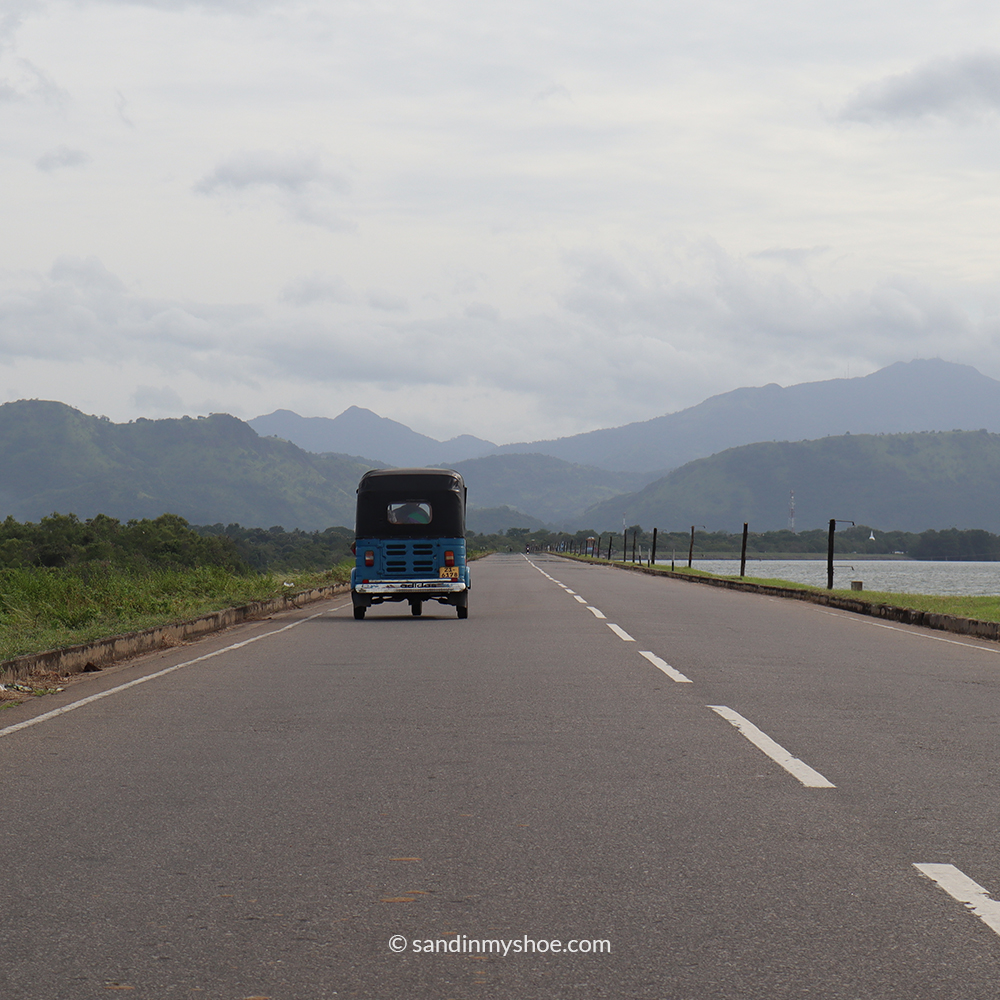
The main thing to be mindful of is the traffic. Roads can be hectic, and the unofficial rule is simple: the biggest vehicle goes first. Expect fast overtakes, buses that don’t slow down, and tuk‑tuks weaving through gaps.
There’s also wildlife on the roads, especially in rural areas. Most often it’s dogs, but in some regions you may even encounter elephants crossing or standing near the roadside.
Sri Lanka is generally a safe place to travel health‑wise, but a few practical precautions will make your trip smoother. Tap water isn’t drinkable, so stick to bottled or filtered water, and be mindful with street food if you have a sensitive stomach. Mosquitoes can be an issue in some areas, especially around dusk, so bring repellent and use it regularly.
Pharmacies are easy to find in towns and cities, but it’s still smart to carry any personal medication you need, plus basics like rehydration salts and painkillers. If you’re heading into rural areas or doing wildlife activities, consider travel insurance that covers medical care and transport.
I found people in Sri Lanka incredibly friendly. In smaller towns, the curiosity level goes up a notch — at times people even wanted to take selfies with me. I remember walking into a small shop in Bandarawela, just to buy a few things, and somehow it turned into a full photo session with the staff.
A bit of preparation goes a long way. My travel tips for Sri Lanka cover the practical things worth knowing before your trip.
My guide to Sri Lankan food walks you through the dishes you’ll see everywhere — from hoppers and kottu to rice & curry, sambols, short eats, and fresh coastal seafood. It also includes a few of my personal favourites from traveling around the island. It’s a useful overview if you want to understand the flavours of Sri Lanka before you arrive.
Most accommodations offer free Wi-fi, but having your own data makes travel days much smoother.
If you want an easy option before you land, an eSIM from Yesim works well in Sri Lanka — you activate it instantly, and get data as soon as the plane touches down.
Sri Lanka has plenty of impressive sights, especially in the area known as the Cultural Triangle, but a few really stand out. Lion Rock in Sigiriya is the big one. The ancient city of Anuradhapura is another must‑see, with huge stupas, sacred temples, and a sense of history that feels very alive.
Add Ella for its viewpoints, Nuwara Eliya for the tea plantations, and either the south coast or the east coast for beach time and water sports — the best coast simply depends on the season.
The train ride from Kandy to Ella — or even better, the Nuwara Eliya to Ella stretch — is a classic. It’s all the same route, but the part between Nuwara Eliya and Ella is where the scenery really peaks, with tea fields, misty hills, and small villages rolling past the windows.
Going on a safari is another must, especially if you want a chance to spot leopards. I visited Wilpattu National Park, which is one of the lesser‑visited parks. It has far fewer tourists than the big-name parks, and the experience feels quieter and more authentic because of it. I also visited the Elephant Transit Home in Udawalawe, which is a great place to see rescued young elephants being cared for before they’re released back into the wild.
If you’re adventurous, renting your own tuk‑tuk and driving across the country like I did. It gives you complete freedom to explore any corner you want, and easily just stop where it looks interesting.. And of course, try surfing — whether you head to the south coast or the east coast depends entirely on the season you’re traveling in.

Sri Lanka has two separate monsoon systems, and they shape the weather far more than simple “best months” lists. Each monsoon hits different regions at different times, which is why the island has opposite seasons on each coast. If you want a full breakdown, I also have a deep‑dive post on the best time to visit Sri Lanka.
Sri Lanka was more expensive than I expected. Outside the tourist hotspots it’s dirt cheap, but inside them, prices rise quickly. I averaged $60/day — staying in private rooms and using a personal tuk‑tuk most of the time. If you stay in dorms and eat local, $30–40/day is realistic.
Accommodation usually eats up a big chunk of the travel budget, but Sri Lanka can be very affordable if you stay slightly outside the main tourist hubs. I paid between $6-25 USD per night and stayed in private rooms the entire time. Having my own tuk-tuk made it easy to book places a bit outside the action while still getting anywhere I wanted.
Getting a street food meal can be as low a dollar or two. A good lunch with meat at a local canteen goes for around ~$1.5 USD, and a coffee at a local place is can be as low as $0.20 USD. But once you step inside the tourist hot spots, and visit places that cater more towards westerners, a cup of coffee is easily $2-3 USD, and a decent meal $6-10 USD.
The local beer, lion lager is about $2-3 USD and a drinks $6-10 USD.
Entrance fees are getting more expensive each year, and foreigners many times pay 100 times more compared to the locals. The cost to visit the Lion Rock is $35 USD for adult foreigners, and for local adults $0.4 USD. The same applies for most entrance fees.
Visiting the ancient capital of Anuradhapura costs foreign adults $30 USD while locals visit it for free.
Activities such as safaris cost me $60 USD for a full day experience in Wilpattu National Park. Renting a simple surfboard in Arugam Bay was $5 USD for a couple of hours. Better boards cost more.
Consider booking your travels through my links if you find my content useful — it supports the site at no extra cost for you.